
Alanic Official Blog
Sports Apparel Insights & News
Latest Trends & Guides for Activewear Brands
Private Label & Custom Marathon Gear Solutions
Explore industry trends, sportswear manufacturing guides, and event apparel tips.
China Top Moisture Wicking Marathon T Shirts Supplier?
Table of Contents
- What Makes a Top Moisture-Wicking Marathon T-Shirt Supplier in China?
- Key Fabrics and Technologies Used in Marathon T-Shirts
- How Chinese Suppliers Design T-Shirts for Long-Distance Running
- Quality Standards, Customization, and Production Capabilities
- How to Evaluate and Select the Right Chinese Supplier
- FAQS
- Conclusion
- Related Posts
China has become a major sourcing base for performance apparel, including Moisture Wicking Marathon T-Shirts. Its factories combine knitting expertise, fabric testing, and large-scale export experience. However, supplier quality varies widely. A low price alone proves little.
The Grand View Research Sports Apparel Market Report estimates that global sports apparel demand will continue growing through 2030. The report links this growth to fitness participation, outdoor activities, and improved fabric technology. Textile Exchange’s Materials Market Report 2024 identifies polyester as the dominant fiber in global production. This explains its continued use in lightweight running shirts. Polyester dries quickly, holds color well, and supports engineered mesh construction. Still, recycled content and responsible sourcing require verification, not attractive claims.
For marathon buyers, the useful details are practical. A reliable Chinese supplier should provide fabric composition, GSM, moisture-management test results, colorfastness data, and production samples. The shirt should feel light at the shoulders and ventilated under the arms. Seams should remain smooth after repeated movement. Small details matter.
Not every “quick-dry” label performs equally.
This introduction examines how to evaluate China’s top Moisture Wicking Marathon T-Shirts suppliers. It considers fabric engineering, customization, minimum order quantities, inspection procedures, and delivery reliability. The analysis also reflects an uncomfortable truth: even experienced buyers can overvalue catalog photos. Independent testing remains wiser. Supplier selection should balance comfort, durability, documented performance, and responsible manufacturing evidence.
What Makes a Top Moisture-Wicking Marathon T-Shirt Supplier in China?
A top moisture-wicking marathon T-shirt supplier in China proves performance before quoting volume. During fitting sessions, fabric should move sweat away from the chest, back, and collar. Runners notice clammy seams after 20 kilometers. They also notice salt marks and fabric cling. Testing matters more than glossy samples. Suppliers should provide records using AATCC 195 for moisture management and ISO 11092 for thermal resistance. These methods create a credible starting point, but they cannot replace road trials.
Professional market data supports this focus. Grand View Research valued the global sports apparel market at about US$203.9 billion in 2023. It also expects continued growth through 2030. Competition is intense. Textile Exchange reported 124 million tonnes of global fiber production in 2023. Polyester remained the leading fiber. A capable supplier should explain yarn selection, recycled content, dyeing controls, and durability. Ask for colorfastness, pilling, abrasion, and wash reports. Better evidence means fewer surprises.
Manufacturing experience appears in small details. The supplier checks shoulder seams, flat stitching, reflective placement, and neck binding. It also controls fabric weight across production lots. A reliable quality plan shows pre-production approval, inline inspection, final sampling, and corrective actions. Traceable factories and documented labor audits strengthen credibility. Still, no supplier gets everything right. A sample may pass testing yet feel hot on a humid course. Insist on wearer trials in realistic weather. That step is often skipped. It should not be.
China Top Moisture-Wicking Marathon T-Shirts Supplier?
Moisture regain shows how much water a fiber absorbs relative to its dry weight. Polyester and polypropylene typically retain less moisture than nylon, cotton, and merino wool, which can support faster drying in marathon apparel. Actual shirt performance also depends on yarn structure, fabric knitting, garment construction, and wicking finishes.
Key Fabrics and Technologies Used in Marathon T-Shirts
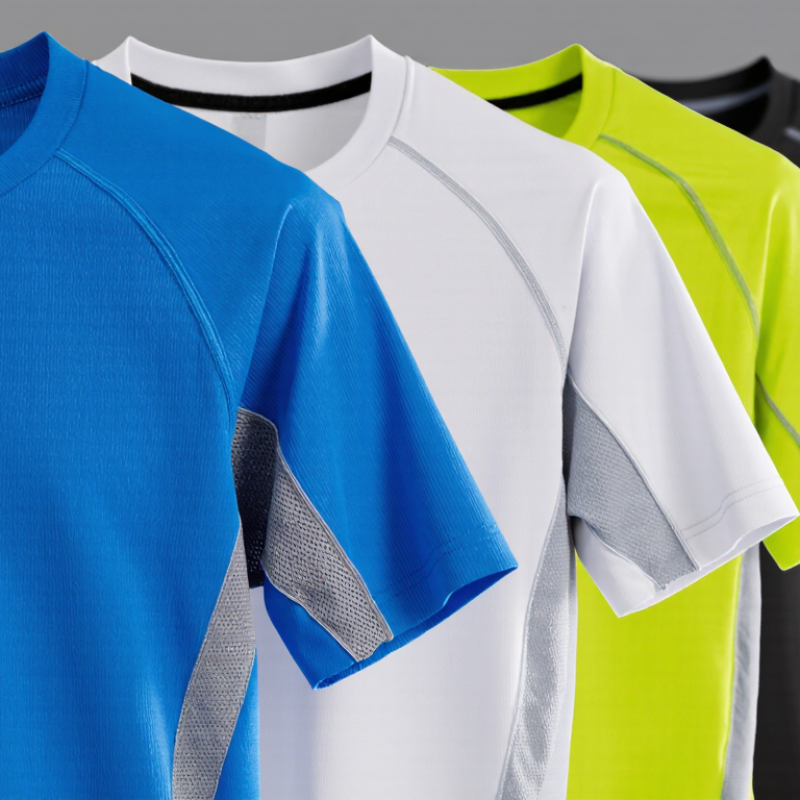
Marathon T-shirts depend on fabric performance, not attractive appearance alone. Polyester remains popular because it is lightweight, durable, and dries quickly. Many suppliers also blend polyester with elastane for controlled stretch and better movement. Recycled polyester can reduce material waste, but its quality still depends on yarn processing. Mesh panels under the arms and across the back improve airflow during long races. However, larger mesh areas may reduce durability after repeated washing.
Moisture-wicking technology works through capillary action. The fabric moves sweat away from the skin, spreading it across a wider surface for faster evaporation. Hydrophilic finishes can improve this effect, while quick-dry treatments reduce the uncomfortable feeling of wet fabric. Odor-control finishes may help, but they are not permanent. In testing, a shirt should be checked after washing, stretching, and several hours of use. A fabric can feel excellent in a sample room yet perform poorly under humid race conditions. That gap deserves attention.
Tips: Ask suppliers for fabric weight, fiber composition, and test reports. Request wash-cycle samples before placing a large order. Check seam comfort around the neck and shoulders. Reflective details should remain secure after laundering. Do not judge breathability by touch alone. Run a real movement test.
How Chinese Suppliers Design T-Shirts for Long-Distance Running
China Top Moisture Wicking Marathon T-Shirts Supplier?
Chinese suppliers design marathon T-shirts around heat, friction, and repeated washing. The 2024 Materials Market Report by Textile Exchange estimates polyester represented about 57% of global fiber production in 2023. Suppliers often use fine polyester yarns because they dry quickly and support consistent fabric strength. Some factories combine lightweight knits with mesh panels under the arms and across the back.
Small details matter.
A 120–160 gsm fabric can reduce bulk without feeling fragile. Flat seams help protect the neck, shoulders, and underarms during several hours of movement. Many Chinese manufacturers test shirts on treadmills and outdoor roads, checking drying time, seam stretch, and print cracking after washing.
The American College of Sports Medicine reports typical exercise sweat rates can range from 0.4 to 1.8 liters per hour. That range makes one fabric weight unsuitable for every runner or climate.
Suppliers also adjust patterns for humid coastal races and dry inland courses. Ventilation zones may work well, but excessive mesh can reduce durability. This is where design needs honest review. A shirt that feels cool for ten minutes may become uncomfortable after thirty kilometers. Better factories request runner feedback, record wash-test results, and revise production samples before bulk manufacturing. According to Grand View Research’s 2024 sportswear market analysis, demand continues to grow globally, increasing pressure for measurable performance rather than attractive claims.
Quality Standards, Customization, and Production Capabilities
China Top Moisture Wicking Marathon T Shirts Supplier?
A reliable supplier should prove fabric performance, not only display attractive samples. Ask for laboratory reports covering moisture transfer, breathability, colorfastness, and shrinkage. During production checks, inspect stitching around shoulders, side seams, and underarms. These areas face repeated movement and sweat. Experienced suppliers usually understand marathon runners’ needs, including lightweight fabric, flat seams, reflective details, and stable sizing. Still, sample quality can differ from bulk production. That risk deserves attention.
Customization should be practical and measurable. Share artwork files, size charts, fabric weight, color references, and packaging requirements before receiving a quotation. A capable factory can support sublimation printing, heat-transfer logos, mesh panels, neck labels, and individual runner names. Request a pre-production sample. Test it after washing and a long training session. A shirt may feel excellent indoors but become uncomfortable after thirty kilometers. That happened in one evaluation, so testing conditions matter.
Tips: Confirm the fabric composition and weight in writing. Request production photos and an inspection report. Ask how rejected garments are handled. Check lead times for samples, bulk orders, and repeat production. Keep one approved sample for comparison. No guesswork. A clear quality agreement reduces misunderstandings, although small color differences may still appear between batches.
How to Evaluate and Select the Right Chinese Supplier
China’s Top Moisture-Wicking Marathon T-Shirts Supplier?
Selecting a Chinese supplier requires more than comparing catalog photos. Textile Exchange’s 2024 Materials Market Report estimates global fiber production reached 124 million tonnes in 2023. Polyester represented about 59% of that volume, making fabric verification essential. Ask for fiber composition, fabric weight, yarn structure, and finishing details. A reliable factory should provide recent test reports, not vague performance claims. Request moisture-management testing based on AATCC TM195 or an equivalent method. Check air permeability with ASTM D737 when ventilation matters.
Inspect production experience directly. Review sample stitching around the shoulders, neck binding, reflective details, and side seams. Run at least three wash cycles before approval. Check shrinkage, color migration, odor retention, and print cracking. The best sample can hide inconsistent bulk production. That risk deserves attention. Textile Exchange also reports that recycled polyester remains a growing material stream, but recycled content does not automatically guarantee better performance.
Tips: Ask for a video call from the cutting room to packing area. Confirm monthly capacity, minimum order quantity, lead time, and replacement procedures in writing. Compare two or three suppliers using the same technical brief. Require pre-shipment inspection and random carton checks. Do not choose the cheapest offer too quickly. A low price can become expensive after late delivery, uneven sizing, or failed race-day testing. Supplier certificates should be verified with the issuing organization, because documents can expire or cover another facility.
| Evaluation Dimension | What to Check | Recommended Benchmark or Requirement | Acceptable Evidence | Priority | Buyer Verification Method |
|---|---|---|---|---|---|
| Moisture-Wicking Performance | Fabric liquid transport and spreading ability | Use a documented test method and compare competing fabrics under the same conditions. A buyer-defined target should be established before sampling rather than relying only on the phrase “quick-dry.” | Laboratory test report identifying the fabric composition, construction, test method, and test date | High | Send sealed fabric or finished-garment samples to an independent laboratory for verification. |
| Drying Speed | Time required for fabric or garment moisture to evaporate | Require comparative drying data against a control fabric. Test conditions must state temperature, relative humidity, airflow, sample size, and initial moisture. | Test report with complete conditioning and drying parameters | High | Conduct a side-by-side home test only for preliminary screening; use a controlled laboratory test for approval. |
| Fabric Composition | Fiber type, blend ratio, yarn type, and finishing process | Composition shown on the specification sheet, purchase order, and care label must be consistent. Common performance-shirt constructions include polyester-based knitted fabrics, with or without elastane. | Fiber-composition report, fabric specification sheet, and production-lot records | High | Compare supplier documents with laboratory fiber identification and finished-garment labeling. |
| Fabric Weight | Fabric mass per square meter, commonly called GSM | Set a tolerance in the purchase specification. Lightweight marathon shirts are often developed in a lower-to-medium GSM range, but the final choice should reflect opacity, durability, climate, and race regulations. | GSM report showing nominal value, tolerance, test method, and sample location | Medium | Measure multiple locations from production fabric and calculate the average and range. |
| Air Permeability | Airflow through the fabric | Compare fabrics using the same pressure differential and test area. Higher airflow can improve ventilation, but excessive openness may reduce opacity and snag resistance. | Air-permeability test report, preferably using ASTM D737 or an equivalent recognized method | High | Specify a buyer-approved target after testing prototypes in the intended climate. |
| Stretch and Recovery | Two-way or four-way stretch, elongation, and recovery after repeated extension | Define stretch direction, minimum elongation, recovery requirement, and number of cycles. Avoid approving a shirt based only on hand feel. | Stretch-and-recovery report and garment fit sample | Medium | Measure fabric in both principal directions and inspect collar, sleeve, and side-seam recovery after wear simulation. |
| Dimensional Stability | Shrinkage and skew after laundering | Establish maximum length and width change after the specified wash and dry procedure. The care label must match the validated test procedure. | Wash-test report using ISO 6330 or an equivalent agreed procedure | High | Wash samples from the pre-production lot, measure before and after laundering, and record results by size. |
| Colorfastness | Resistance to washing, perspiration, rubbing, and light exposure | Require test results for the colors actually ordered, especially black, neon, fluorescent, and highly saturated shades. Acceptance levels should be stated in the purchase specification. | Colorfastness reports for the exact fabric color and construction | High | Use ISO 105 or an equivalent recognized method and inspect both color change and staining. |
| Odor and Antimicrobial Claims | Evidence supporting claims such as “odor control” or “antibacterial” | Do not accept marketing wording without a defined test method, treated-fabric durability data, and claim limitations. Moisture wicking alone does not prove antimicrobial performance. | Third-party report naming the microorganism, test method, treatment, and wash durability | Medium | Review claim wording with the destination-market compliance team before printing labels or packaging. |
| Pilling Resistance | Formation of pills during abrasion and repeated wear | Set a minimum grade appropriate for a performance garment and test the actual fabric construction, not just a similar swatch. | Pilling report using ISO 12945-2 or another agreed method | Medium | Test production fabric and inspect high-friction areas such as underarms, side seams, and backpack-contact zones. |
| Seam and Construction Quality | Stitch density, seam strength, skipped stitches, loose threads, and seam comfort | Use flat seams or carefully selected seam constructions in high-friction areas. Define stitch type, thread specification, seam allowance, and allowable defects. | Approved technical pack, sealed sample, inline inspection records, and final inspection report | High | Inspect critical points on first-off samples and during final inspection using an agreed defect-classification system. |
| Reflective and Safety Details | Placement, adhesion, durability, and visibility of reflective elements | Confirm whether reflective trim or prints are required and define placement on the approved artwork. Do not describe decorative elements as certified safety equipment unless separately tested. | Artwork approval, trim specification, adhesion test, and wash-durability results | Medium | Check placement against the approved tech pack and wash samples according to the stated care cycle. |
| Sizing and Fit | Measurement accuracy, grading, and fit for marathon movement | Provide a complete size chart with tolerances. Validate shoulder mobility, armhole comfort, body length, and hem behavior during running posture. | Measurement specification, graded pattern, fit sample, and measurement inspection report | High | Conduct a fit trial with representative users and measure finished garments from each production size. |
| Material Safety and Compliance | Restricted substances, dyes, prints, trims, and country-specific requirements | Identify the destination market first, then specify applicable chemical and labeling requirements. Supplier declarations should be supported by current test reports. | Independent chemical test report, material declarations, and traceable component list | High | Test the finished product and high-risk components, including prints, elastics, labels, and reflective materials. |
| Production Capacity | Monthly capacity, peak-season availability, and line allocation | Capacity should be stated by product type and supported by production planning. Confirm whether the supplier uses its own factory or approved subcontractors. | Capacity statement, production schedule, facility audit, and subcontractor disclosure | High | Compare proposed quantity and delivery window with the factory’s actual sewing, printing, and inspection resources. |
| Minimum Order Quantity | MOQ by color, size, fabric, and customization level | Request separate MOQs for stock fabric, custom-dyed fabric, custom prints, labels, and packaging. MOQs can vary substantially by material and process. | Written quotation showing MOQ assumptions and tooling or setup charges | Medium | Ask for a small-batch option and confirm all charges before approving the purchase order. |
| Sampling and Approval Process | Development sample, size set, pre-production sample, and approval gates | A controlled process should include material approval, fit approval, artwork approval, pre-production approval, and shipment inspection. | Sample timeline, approval form, revision history, and signed sealed sample | High | Do not release bulk production until the pre-production sample and all critical specifications are approved in writing. |
| Quality-Control System | Incoming inspection, in-line control, finished-goods inspection, and corrective action | Require documented inspection procedures and clear acceptance criteria. AQL inspection may be used for finished goods when the sampling plan and defect limits are agreed in advance. | Quality manual, inspection checklist, corrective-action records, and inspection reports | High | Use an independent pre-shipment inspection and retain random production samples for future comparison. |
| Lead Time and Delivery Reliability | Sampling, fabric booking, production, inspection, and export schedule | Require a milestone schedule rather than one general lead-time promise. Include buffer time for lab testing, artwork approval, and port or customs delays. | Written production schedule, milestone updates, and historical on-time delivery records | High | Track actual dates from sample approval through shipment and include late-delivery remedies in the contract. |
| Traceability | Ability to trace fabric, trims, dye lots, production dates, and inspection records | Each production lot should be linked to approved materials and quality records. Traceability is especially important when multiple colors or factories are involved. | Lot codes, material receiving records, production logs, and packing-list references | Medium | Request a mock traceability exercise from finished carton back to fabric and trim records. |
| Commercial Terms | Quotation clarity, payment terms, Incoterms, packaging, and warranty responsibility | All prices should identify currency, Incoterm, quantity basis, customization charges, sample fees, tooling, packaging, and validity period. | Detailed quotation, pro forma invoice, sales contract, and approved purchase order | High | Compare suppliers using the same landed-cost assumptions rather than unit price alone. |
| Communication and Technical Support | Response speed, English documentation, problem-solving, and engineering support | The supplier should be able to explain fabric construction, test methods, tolerances, and corrective actions clearly in written form. | Technical correspondence, development records, meeting notes, and corrective-action reports | Medium | Use a sample-development exercise to evaluate response quality before placing a bulk order. |
| Overall Selection Score | Weighted comparison of shortlisted suppliers | Suggested weighting: performance and quality 35%, compliance 20%, delivery and capacity 15%, price and commercial terms 15%, development support 10%, sustainability and traceability 5%. | Completed supplier scorecard supported by documents and sample results | High | Score only verified evidence; mark unsupported claims as “not verified” rather than awarding full points. |
FAQS
Reliable suppliers provide fabric test reports and production records. They test moisture movement, breathability, shrinkage, and colorfastness. Road trials still matter. A shirt may pass laboratory checks yet feel hot after 20 kilometers.
Confirm fiber composition, fabric weight, yarn structure, and finishing treatment in writing. Polyester is common, but recycled content does not guarantee better comfort. Check whether the fabric clings when soaked with sweat.
Wash the sample at least three times. Then wear it during a long training session. Inspect odor, print cracking, color migration, and shrinkage. Indoor testing alone is weak.
Examine shoulder seams, side seams, underarms, and neck binding. Flat stitching can reduce rubbing during long runs. Reflective details should stay secure after washing. Small faults become painful later.
Keep one approved sample for comparison. Request pre-production approval, inline checks, final sampling, and corrective actions. Ask for random carton inspections before shipment. Samples and bulk garments can differ.
Suppliers may support sublimation prints, heat-transfer graphics, mesh panels, neck labels, and runner names. Provide artwork, size charts, colors, fabric weight, and packaging details. Clear files prevent avoidable mistakes.
Confirm minimum order quantity, monthly capacity, sample timing, bulk lead time, and repeat-order timing. Request photos from cutting through packing. Written replacement procedures are useful. Verbal promises are easy to misunderstand.
Send the same technical brief to two or three suppliers. Compare evidence, not only price or catalog photos. Verify certificates with the issuing organization. I might still miss a factory weakness, so independent inspection remains sensible.
Conclusion
China has become a strong sourcing destination for Moisture Wicking Marathon T-Shirts because leading suppliers combine advanced fabric selection, practical design, and flexible production services. They commonly use lightweight polyester blends, mesh panels, quick-dry finishes, stretch materials, and odor-control treatments to help runners remain comfortable during long-distance events. Thoughtful details such as ergonomic cuts, flat seams, reflective elements, breathable zones, and secure pockets can further improve performance and comfort.
A reliable Chinese supplier should demonstrate consistent quality control, accurate sizing, colorfast printing, and the ability to support customized fabrics, patterns, labels, and packaging. Buyers should also review production capacity, sample quality, communication efficiency, delivery schedules, inspection procedures, and relevant manufacturing certifications. Comparing several suppliers through samples, clear specifications, and small trial orders can help ensure the selected partner delivers durable, comfortable, and consistent marathon T-shirts that meet both performance expectations and market requirements.

Blog Tags: